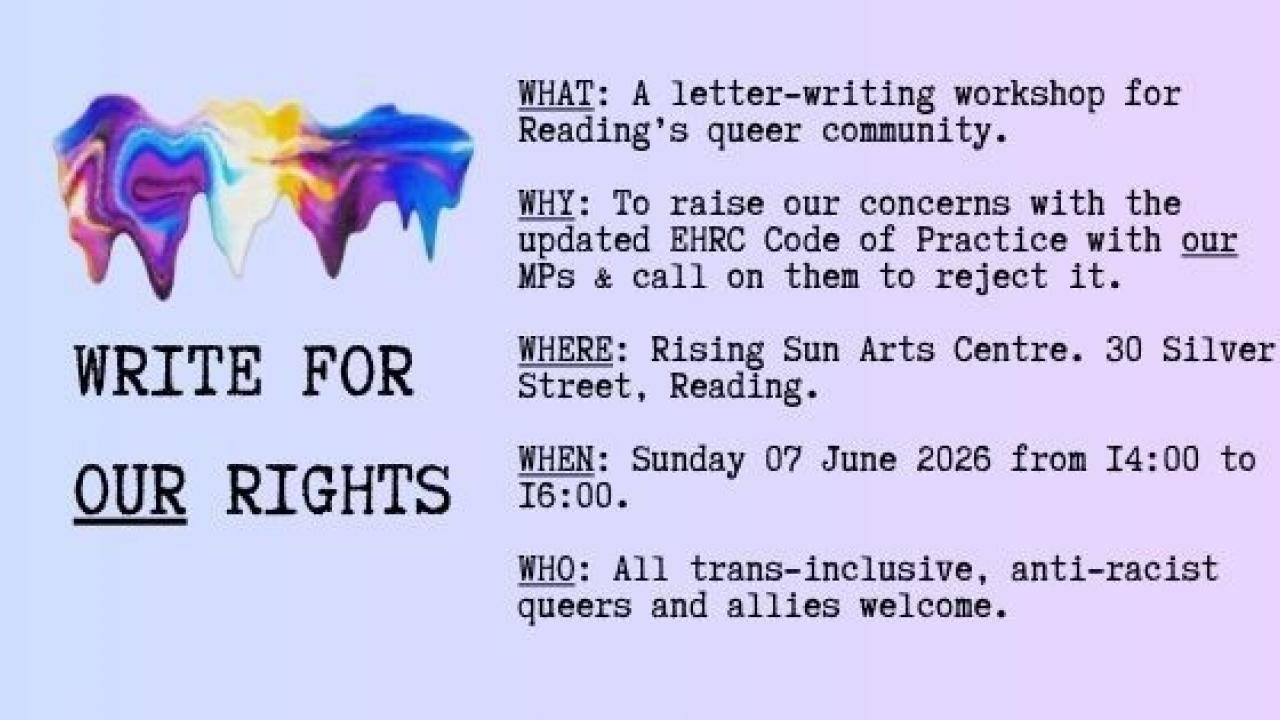







































Recent developments in law and policy remind us that while LGBTQIA+ rights are hard won, they can never be taken for granted. The Equality and Human Rights Commission's (EHRC) updated Code of Practice for Services, Public Functions and Associations, laid before Parliament on 21 May 2026, will have drastic negative consequences for transgender and other LGBTQIA+ people across the UK, institutionalising exclusion, forced outing, and segregation. With Parliament currently considering the code, now is a crucial moment to ensure that our voices are heard. Parliament has 40 days from the laying date to review the code. If Parliament does not reject the code, it will become law.
While social media can help raise awareness, build momentum, and connect communities, meaningful political change also depends on direct engagement with decision-makers. Writing to elected representatives remains one of the most accessible and effective ways to influence policy, communicate lived experience, and hold those in power accountable.
There are already signs that parliamentarians are listening. On 1 June 2026, Nadia Whittome MP tabled an Early Day Motion calling for the draft code to be disapproved. The motion has since attracted support from MPs across Labour, the Liberal Democrats, the Green Party, the SNP, the SDLP, and independent benches. Whether or not your MP has signed the motion, this is an important opportunity to ensure that our elected representatives hear directly from the LGBTQIA+ people and communities who stand to be affected.
In this community-led workshop, we will focus on the EHRC's proposed Code of Practice as a case study in democratic engagement. Together, we’ll explore what it means to write for our rights through letter-writing campaigns aimed at elected representatives at both local and national levels. We’ll look at proven strategies for effective advocacy, including finding common ground, drawing on personal experience, building rapport, and crafting arguments that are clear, persuasive, and difficult to ignore. We’ll also discuss how individual letters can become part of wider campaigns for change, and how communities can organise collectively to influence decisions that affect their lives. Together, our voices are stronger.
By the end of the workshop, you’ll have a draft letter ready to send, a clearer understanding of how policy change happens, and practical resources to support future advocacy and letter-writing campaigns.
The time to write for our rights is now. The parliamentary scrutiny period is a rare opportunity to intervene before policy becomes practice. Let’s write alongside one another to ensure that concerns about the avoidable harms this code could cause for LGBTQIA+ people and communities are heard by those responsible for scrutinising and implementing it.